ENROLLMENT CLOSES SOON. MAKE SURE TO SAVE YOUR SPOT HERE
MARCH MASTERCLASS
Transforming Workaholism: Achievement as Armor for the Unloved Child
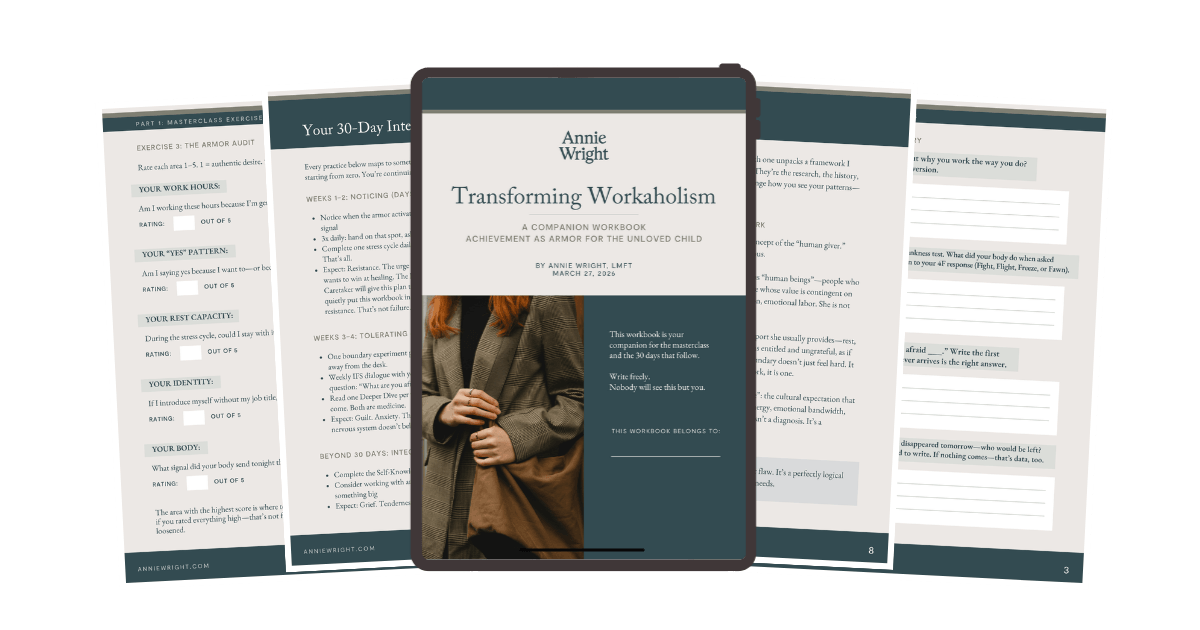
A 90-minute live workshop for women who suspect their relationship with work crossed a line somewhere—from ambition into something more compulsive, more costly, and harder to stop than anyone around them understands.

You know this isn’t just “being ambitious” anymore.
Ambitious women work hard and feel good about it. You work hard and can’t stop—even when your body is begging you to. Even when the vacation is booked. Even when everyone around you says “slow down” and you nod and agree and open your laptop at 11 PM anyway.
That’s not ambition. That’s workaholism. And it’s the best-dressed addiction there is—because nobody stages an intervention for the woman who’s killing it at work.
Here’s what it actually looks like from the inside:
The 2 AM email scroll—not because there’s a crisis, but because the quiet feels worse than the work. The Sunday dread that shows up at 4 PM like clockwork. Going completely blank when someone asks, “What do you actually want?”—because your brain can only translate that question into: What should I be doing?
You’ve tried to stop. Or at least slow down. You’ve set the boundary, blocked the calendar, sworn this would be the vacation you actually rested on. And then your nervous system overrode every single one of those decisions—because doing less didn’t feel like rest. It felt like you were going to crawl out of your skin.
That compulsion—the one that looks like dedication from the outside but feels like a trap from the inside—isn’t random. It isn’t a time management problem. And it isn’t fixed by a better morning routine.
It’s wiring. Installed early. Reinforced often. And running your life.

Where workaholism actually comes from
Most people think workaholism is about loving your job too much. It’s not. It’s about what work protects you from feeling.
For many women, the pattern started in childhood. The parent who was supposed to look at you doing nothing on the couch and think there she is—instead looked at you and evaluated. Measured. Your value lived in your output. Love was something you earned with your grades, your helpfulness, your impossible reliability. Sitting still was dangerous—because sitting still meant you weren’t earning your place.
So your brain built a highway: Achievement → dopamine hit → brief sense of safety → something that almost feels like love. Almost.
By adulthood, that highway runs on autopilot. When someone says “You’re such a hard worker” and it lands like oxygen? That’s the old wiring. That’s the child inside you hearing: You’re safe. For now.
And then you chase the next hit. The next project, the next deadline, the next inbox zero. Not because you want to—but because your nervous system has made work the only place it knows how to feel okay. That’s the compulsive part. That’s what makes it an addiction, not a preference.
For some of you, this didn’t start in childhood—or at least, that’s not where it got loudest. Maybe it was the workplace that celebrated “heroic hours” and called burnout “dedication.” Financial pressures that made rest feel reckless. A mission-driven culture that weaponized your passion into guilt. The origin matters less than this: somewhere—in your family, in your workplace, on the structural ground you were born onto—your nervous system learned to use work the way other people use a drink—to numb, to manage, to avoid whatever’s underneath.
And the thing underneath? It’s almost always the same: a hunger that no amount of achievement can feed. Because the hunger was never for the promotion, the title, or the revenue milestone. It was for the feeling you never got as a child: I see you. I’m proud of you. You’re enough—just as you are.
You keep feeding it the wrong thing. And it never gets full.
The life you’ve built is beautiful from the outside—impressive, admirable, everything you were supposed to want. But the proverbial foundation underneath—the neural pathways and beliefs about worth that were poured when you were small—has never been repaired. You keep decorating the upper floors while the basement floods. This workshop goes to the basement.

Why you can’t just stop
You’ve tried. That’s the part that makes this different from being “a hard worker.”
A hard worker can take the vacation and enjoy it. You take the vacation and by noon on day one your heart is racing, your hands are restless, and you’re flooded with the conviction that something terrible is about to happen—not because anything is wrong, but because nothing is happening. Your system reads quiet as danger.
A hard worker finishes the project and feels satisfied. You finish the project and feel… nothing. Or you feel a brief flash of relief that evaporates in minutes, and you’re already scanning for the next thing. The promotion lands and you think: Why don’t I feel anything? Everyone else would be celebrating. You can’t access it. The hit wore off before it even arrived.
A hard worker rests on Sunday. You spend Sunday with a low-grade dread humming underneath everything, your body restless, your mind composing Monday’s to-do list by 4 PM—because your nervous system was calibrated to high alert in childhood and it never came back down. It reads productivity as safety. Stillness as threat. A quiet evening alone as something your body needs to flee.
That’s not laziness or a bad attitude toward rest. That’s a nervous system running survival software it installed decades ago—software that made rest feel dangerous because, when you were small, stillness really did mean danger.
This is why willpower doesn’t work on workaholism. You’re not fighting a bad habit. You’re fighting wiring. And wiring doesn’t change because you decided it should. It changes when your nervous system has a new experience—when your body learns, in real time, that stillness isn’t going to kill you.
That’s what this workshop is designed to give you.
WHAT MAKES THIS DIFFERENT
Most approaches to workaholism hand you a time-blocking template and tell you to “set better boundaries!” Like the problem is your calendar.
They skip the questions that actually matter:
Why does stopping feel dangerous—physically dangerous, in your body?
(Is your nervous system confusing stillness with the vulnerability that got you hurt as a child?)
Is your work ethic yours—or is it survival software you never chose to install?
What’s the hunger underneath the drive? What are you actually chasing when you open the laptop at midnight—and why does getting the thing never feel like enough?
Why can’t you answer “What do you want?” without your mind going blank?
This workshop starts there. Not with your calendar. With your nervous system. With why your body treats a quiet Sunday like a five-alarm fire and why achievement hits your bloodstream like a drug and dissolves just as fast.
Then we do something most workshops never attempt: we give you the experience—in real time, in the room—of completing a stress cycle your body has been holding for years. Maybe decades. Not learn about it. Do it. Your body already knows how. It’s been waiting for permission.
You’ll also meet the internal part of you that’s been driving the workaholism—using Internal Family Systems, a clinical model developed at Harvard and validated in randomized controlled trials—and hear what she’s actually afraid will happen if you slow down. That conversation changes everything. Because the fear she names is almost never about work. It’s about love. Safety. Being left.
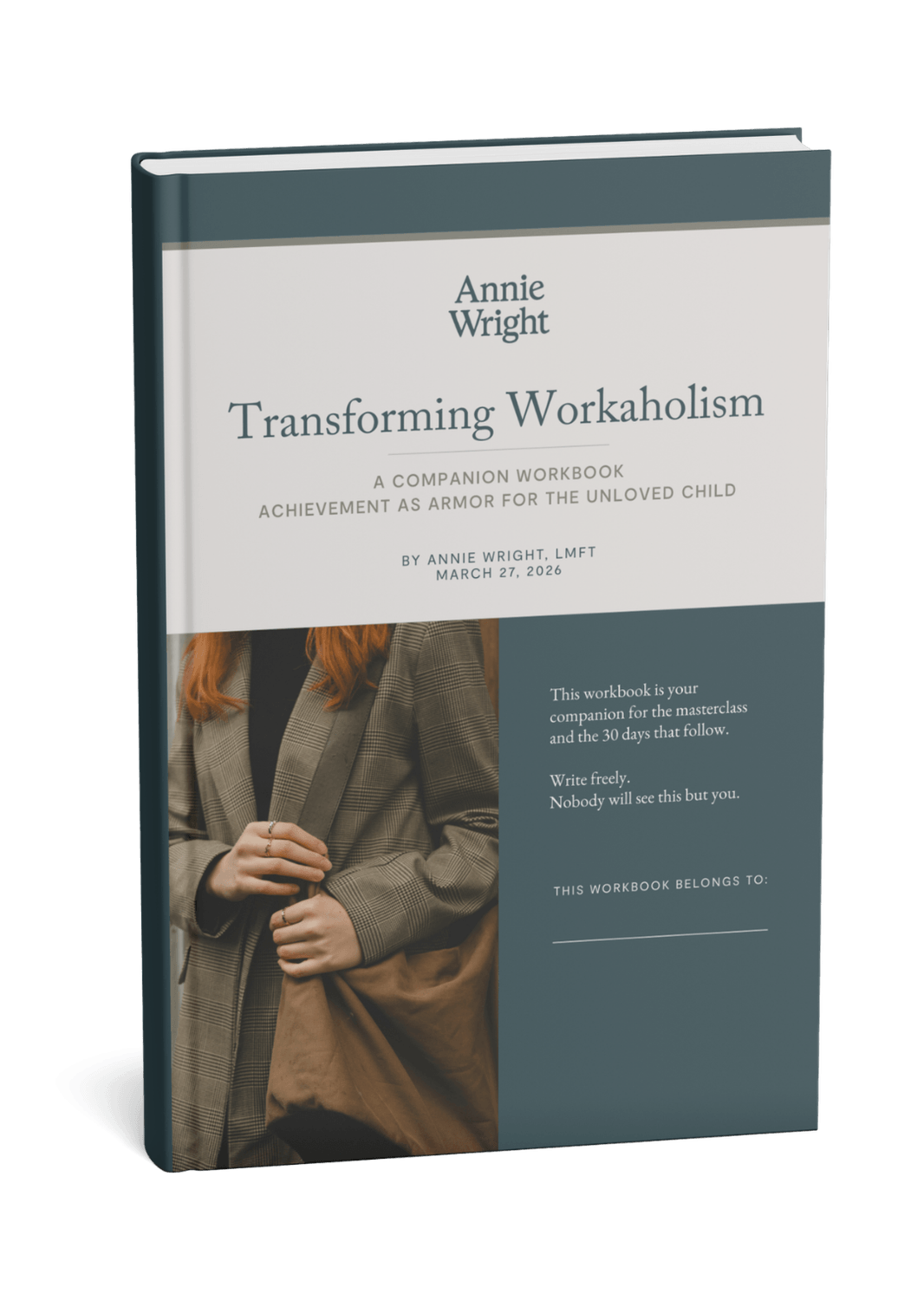
And you’ll walk away with a complete workbook and 30-day integration plan so the shift doesn’t evaporate the moment you close Zoom—because workaholism is a pattern, and patterns need more than one evening to change.

In 90 minutes, you'll walk away with:
Your Achievement Archetype identified—discover which of the Four Achievement Archetypes is running your workaholism and finally understand why your version of overwork looks the way it does:
The Sprinter (Flight): You can’t stop moving. Your calendar is a fortress. Stillness feels like dying.
The Perfectionist (Fight): You can’t let go of control. Every email proofread three times. Your standards aren’t high—they’re a wall.The Caretaker (Fawn): You can’t say no. “What do I want?” becomes “What does someone need from me?” Your overwork looks like generosity—but you’re disappearing behind the giving.
The Ghost (Freeze): You can’t feel anything. You work on autopilot—not driven, but disconnected. Your mind goes blank. You’ve vanished from your own life.
Your 4F trauma response named—understand which survival response (Fight, Flight, Freeze, or Fawn) is fueling your workaholism, and watch yourself catch it in the act during a live experiential exercise where I ask one question and your nervous system answers before your brain can intervene
The neuroscience translated—in plain language, not jargon: why your nervous system treats productivity as safety and stillness as threat, why the achievement-dopamine cycle feels exactly like an addiction (because neurologically, it is), and why willpower alone can’t fix it
One completed stress cycle—experience, in real time, what it feels like to close the gap between the stressor and the stress. Your body has been storing uncompleted cycles for years—in your jaw, your shoulders, your 2 AM insomnia. We finish one. Together. On Zoom. Not learn about it. Do it.
A guided IFS dialogue with your internal “Manager”—meet the part of you that drives the overwork, put your hand on the place in your body where she lives, and ask her what she’s actually afraid will happen if you slow down. The answer is almost never about work. This is the moment most women say everything shifted.
The Both/And framework—not “achievement OR well-being” but “achievement AND well-being,” because the either/or thinking itself is survival wiring. You don’t have to choose between your ambition and your ability to feel alive.
A letter to the child who built the armor—a guided closing exercise that lets you speak directly to the younger version of yourself who decided work was the only safe place. She needs to hear from you.
A complete masterclass workbook + 30-day integration plan with:
The Armor Inventory (what’s your 2 AM story about why you work this way?)
The Achievement Archetype assessment (with body-location mapping)
The Armor Audit (rate each area of your life 1–5: authentic desire vs. pure armor)
Deeper Dives into the research and systems underneath your workaholism—the human giver framework, the labor of love trap, the bootstrapping myth, intergenerational transmission, and why the question of who gets to rest is structural, not personal
The stress cycle completion practice and IFS dialogue you can repeat at home
A 30-day integration structure so the work actually lives in your body and your week
Friday, March 27, 2026 | 2:00–1:30pm Eastern | Live on Zoom
$47
90-minute Live Workshop
Lifetime Recording Access
Robust Companion Workbook
30‑day Integration Plan
Less than a co-pay. More than most people invest in understanding the pattern that’s running their life.
Limited to 100 participants to keep it interactive.
What's included
90-minute live workshop on Zoom (camera optional, no forced sharing—there’s no wrong way to do this)
Four experiential moments designed to move workaholism from concept to felt experience in your body—including a live stress cycle completion and a guided IFS dialogue
Live Q&A to get your specific questions answered
Lifetime access to the recording so you can revisit the frameworks and experiential practices anytime
The Four Achievement Archetypes framework you can use on any work pattern, any stress response, for the rest of your life
A robust companion workbook + 30-day integration plan (delivered before the session) with everything you need to do this work properly:
The Achievement Archetype assessment to identify your pattern, its 4F root, and where it lives in your body
The Armor Inventory and Armor Audit with reflection questions
The neuroscience of your nervous system’s high-alert setting—in plain language, not a textbook
The stress cycle completion practice with step-by-step instructions you can use at home
The IFS “Meeting Your Manager” dialogue you can repeat on your own
The Both/And framework for sustainable change
Deeper Dives into the research, history, and politics underneath your workaholism—the human giver framework, the labor of love trap, the bootstrapping myth, intergenerational transmission, and why the question of who gets to rest is structural, not personal
A guided letter-writing exercise for the child who built the armor
A flexible 30-day integration structure (start before the masterclass, follow along live, or begin afterward—your timeline, not mine)
Writing space for every exercise—this isn’t a flimsy PDF, it’s a working document you’ll return to all year
This is for you if:
You’ve tried to slow down and your nervous system overrode the decision—the boundary lasted a week, the vacation felt like punishment, the blocked calendar got unblocked by Tuesday
Your relationship with work has crossed from ambition into something more compulsive—and you can feel the difference even if you can’t name it
You grew up in a home where love was conditional on performance—where being “good” meant being useful, excellent, or invisible
The question “What do you actually want?” makes your mind go blank—or immediately rearranges itself into “What should I be doing?”
You’ve hit a milestone you worked years for and felt… nothing. Or a brief flash of relief that dissolved before you could hold it
Rest feels dangerous. Or boring. Or like something you haven’t earned. Or like your skin is crawling
You’re the person everyone calls when things fall apart—and nobody thinks to ask how you’re doing
You work through illness, through exhaustion, through vacations—and part of you feels proud of that, and part of you knows something is wrong
You suspect the hunger underneath your drive isn’t about work at all—and you’re ready to find out what it’s actually about
Your workplace culture, financial pressures, or mission-driven field reinforced the pattern—and you need someone to address the wiring, not just the calendar

This is not for you if:
You want productivity hacks or a better time-blocking system
You’re looking for permission to burn out more efficiently
You’re not willing to look at what your workaholism is protecting you from—whether that’s a childhood wound, a cultural pressure, or both
You prefer advice that stays at the surface
What happens if you don’t understand your workaholism?
You'll do what you did last year:
White-knuckle through another quarter and call it “busy season”.
Scroll email at 2 AM and tell yourself it’s dedication—not that the quiet is unbearable.
Cancel the vacation. Skip the lunch break. Feel a flash of pride about it and a wave of dread underneath.
Hit the milestone and feel… nothing. Wonder what’s wrong with you. Chase the next one.
Pour more of yourself into work while your body sends signals you keep overriding—the jaw tension, the insomnia, the back that goes out the week you can’t afford it.
Arrive at March 2027 in the same compulsive cycle, asking the same questions, feeding the same hunger with the same thing that never fills it.
Or you can spend 90 minutes this March understanding what your workaholism is actually about—what it’s protecting, what it’s chasing, and why willpower hasn’t been enough to change it.
Here’s what women tell me after doing this work: Better sleep—not because they found a better supplement, but because their nervous system stopped treating bedtime as a threat. Less dread before Monday meetings. More presence with their kids instead of mentally composing emails during bath time. The ability to sit on the couch on a Sunday evening and feel something they couldn’t name at first.
One woman told me the word was “safe.” Not because she’d finished her to-do list. Because she was sitting still and nothing terrible was happening. That’s what’s on the other side. Not perfection. Just a life that feels as good to live as it looks from the outside.
Walk away with:
Frameworks that name the addiction for what it is—without shame, without pathologizing your ambition, without telling you to just slow down
Practices to complete the stress cycles your body has been holding for years
A guided conversation with the part of you that drives the overwork—and the chance to hear what she’s actually afraid of
A concrete, gentle 30-day plan to begin changing the wiring—not just the schedule
Friday, March 27, 2026 | 2:00–1:30pm Eastern | Live on Zoom
$47
90-minute Live Workshop
Lifetime Recording Access
Robust Companion Workbook
30‑day Integration Plan
Less than a co-pay. More than most people invest in understanding the pattern that’s running their life.
Limited to 100 participants to keep it interactive.
Testimonials
HAVE QUESTIONS?
Frequently Asked Questions
You’ll get lifetime access to the full recording and the workbook. Many participants do the workbook exercises on their own schedule and rewatch the parts that land the hardest.
No. This is an educational workshop. It may be therapeutic, but it’s not a substitute for therapy or individualized treatment.
No one will be forced to share. You’re welcome to keep your camera off, participate in the chat only, or simply listen and work quietly in your workbook.
Yes. There are no upsells required to get the core content, recording, or workbook.
Here’s the question I’d ask: Have you tried to slow down—and watched your nervous system override the decision? The boundary that lasted a week. The vacation that felt like punishment. If you’ve tried to stop and can’t, that’s the marker. That’s what this workshop addresses.
No. Whether the pattern started in a family where love was conditional on performance, or in a workplace, a culture, or a financial pressure that made rest feel reckless—the nervous system wiring is similar. This workshop is designed for all of it.
Because insight alone isn’t enough—your body has to learn that slowing down is safe. We’re combining frameworks with nervous‑system‑aware practices, including a live stress cycle completion and an IFS dialogue, plus a 30‑day structure so the work lands in your body, not just your mind.
No. The framework is Both/And—achievement AND well‑being. You keep your ambition. You change the wiring underneath it so your drive comes from desire instead of fear.

YOUR FACILITATOR
Annie Wright, LMFT

I’m a licensed therapist with over 15,000 clinical hours working with driven women from complicated families—physicians, nonprofit directors, tech executives, founders, lawyers, educators. Women whose impressive lives don’t feel as good as they look. Women whose workaholism everyone admires and no one questions.
My specialty is the intersection of relational trauma and high achievement—how the survival strategies that made you brilliant at your job became the compulsive patterns that now run your life. I’ve been where you are. I know what terror in a blazer looks like because I wore it for years. This workshop comes from that reckoning—and from the frameworks and practices I now use with clients to help them keep their ambition without letting it cost them everything else.